
Wind turbine propeller modeling in heliciel
Wind pump: how it works, number of blades and choice of pump
A wind pump delivers water, not electricity: it must therefore work over the widest possible range of wind and start with a high torque. The type of pump it drives (piston, screw, centrifugal or electric) decides the number of blades and the rotation speed of the rotor. A piston pump calls for many blades; a centrifugal pump allows fewer; an electric pump leaves the rotor choice free.
We compare these four families of pumps, with their advantages and limits. On this page:
- 1: The wind pump and its water need
- 2: Number of blades and tip speed ratio
- 3: Wind turbine with a piston or screw pump
- 4: Wind turbine with a centrifugal pump
- 5: Wind turbine with an electric pump
1: The wind pump and its water need
Wind pumps are designed to provide water. The need for water is such that their objective differs slightly from that of a power-generating wind turbine. The wind pump must run over the widest possible range of wind, because the site is no longer chosen for profitability: we must produce water throughout the dry season, whatever the wind.
There are several categories of wind pumps, depending on the type of pump they operate:
- wind turbine with a piston pump;
- wind turbine with a screw pump;
- wind turbine with a centrifugal pump;
- wind turbine with an electric pump.
2: Number of blades and tip speed ratio of a wind pump
The rotation speed and torque of the driven machine call for a suitable number of blades. A small number of blades is enough to capture the energy of the rotor disc only if the rotation speed is high. If it is low, a large part of the wind passes through the rotor without meeting the blades. The tip speed ratio measures this relation: it is the blade tip speed divided by the wind speed.
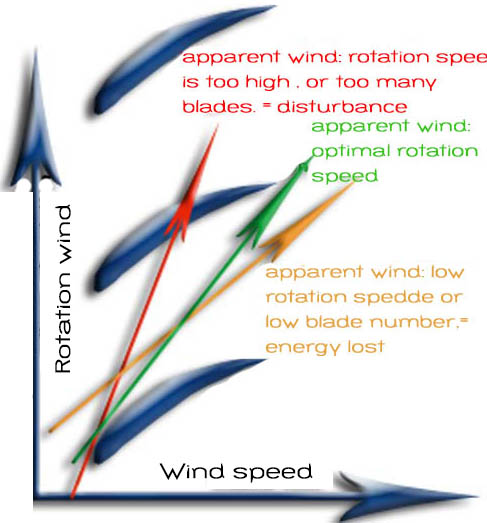
The apparent wind according to rotation speed. In red, rotation speed or number of blades too high: the blades disturb one another. In orange, speed or number of blades too low: fluid passes through unused. In green, the optimum. The labels in the figure are in French.
High tip speed ratios:
| Advantages | Disadvantages |
| Captures the energy with a small number of blades, so brings the advantages of few blades: low manufacturing cost. | The projection of drag and lift forces is less favourable, which demands good quality sections, sometimes complex to make. |
| The tangential rotation of the flow downstream of the rotor reveals the energy lost by the system. At equal power (P = torque in N.m × rotation speed in rad/s), a high rotation speed uses less torque, so generates fewer losses. | The starting torque is often insufficient to start at low wind speeds: starting assistance is sometimes needed. |
| Rotation speed closer to that of generators (the generator and gearbox will be cheaper). | Rotation speed and torque unsuited to pumping. |
| Little exposure to violent winds, by feathering. |
Low tip speed ratios:
| Advantages | Disadvantages |
| Allows simple blade shapes, cheap to manufacture. | To get a good efficiency, many blades are needed (more expensive, heavier, more exposed to the wind in storms). |
| Starts even at low wind speeds. | The tangential rotation of the flow downstream of the rotor reveals the energy lost by the system. At equal power (P = torque in N.m × rotation speed in rad/s), a low rotation speed uses more torque, so generates more losses. |
| Rotation speed and torque well suited to pumping. | Rotation speed unsuited to generators (the generator and gearbox will be more expensive). |
3: Wind turbine with a piston or screw pump: a high starting torque
The slightest breath of air must be usable, and the torque needed to operate a piston pump is much higher than that of an electric generator. To produce torque on the rotor shaft at start-up, so at low speed, we must use all the energy of the wind crossing the rotor.
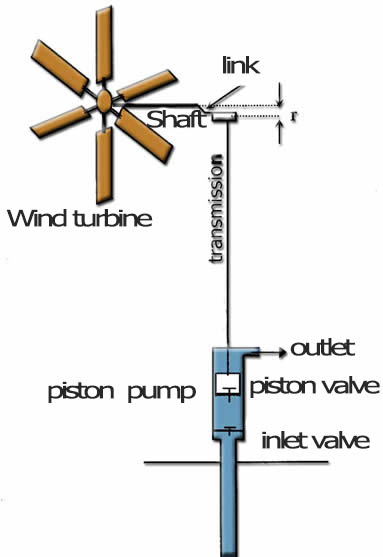
A wind pump with a piston pump: the rotor shaft drives a connecting rod, which operates the piston of the pump through a transmission rod. The labels in the figure are in French.
Wind turbines that need a high starting torque, such as those driving a piston pump or a screw pump, must therefore have a high number of blades.
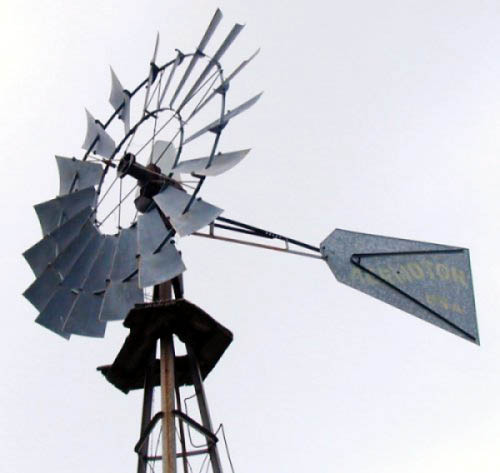
A classic multi-blade wind pump, with the tail vane that keeps it facing the wind.
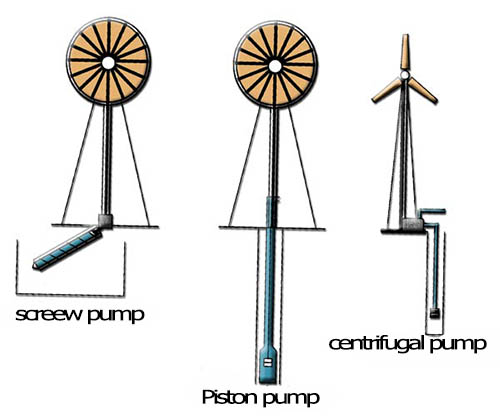
The three families side by side: screw pump and piston pump with a multi-blade rotor, centrifugal pump with a three-blade rotor. The labels in the figure are in French.
The disadvantages of a wind turbine driving a piston pump:
- The cost of the blades, which must be numerous, raises the cost of the pumping system.
- The reciprocating motion of the pumping means the fluid velocity goes from 0 to a maximum. This maximum is much higher than for a centrifugal pump. It generates head losses that can be up to eight times greater than for pumping at constant speed. These head losses cause pressure surges that weigh on the loads and fatigue of the mechanism. They force oversizing and cause wear.
The power of a wind turbine rotor increases with the cube of the wind speed. To capture this power efficiently, the wind turbine must turn faster; the relation between rotation speed and power therefore increases cubically. Yet the piston pump is a positive-displacement pump, whose speed-power relation is practically proportional, so linear.
The wind turbine and the pump thus have only one zone of optimum efficiency. As soon as this zone is exceeded, the wind turbine loses a lot of energy, because its power-rotation speed curve is no longer used to best advantage.
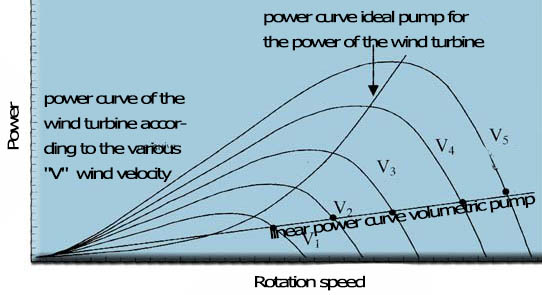
Rotor power curves for wind speeds V1 to V5, and the power line of the positive-displacement pump. The line crosses each curve far from its peak: the wind turbine is used well for only one wind speed. The labels in the figure are in French.
4: Wind turbine with a centrifugal pump: fewer blades, an adaptable curve
Wind pumps that drive a centrifugal pump have a lower operating torque: the number of blades can therefore be reduced.
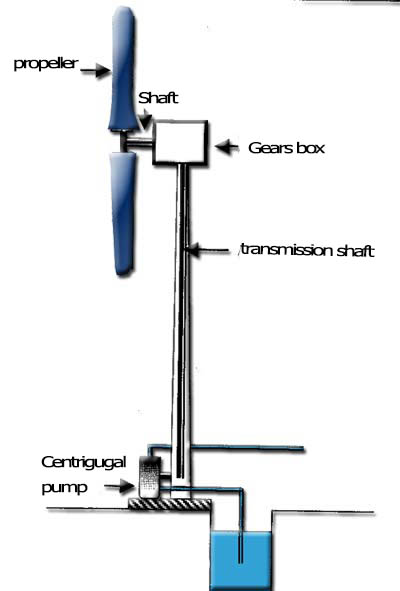
A wind pump with a centrifugal pump: a gear multiplier speeds up the rotation of the rotor shaft, which the transmission shaft carries down to the pump. The labels in the figure are in French.
In addition, the speed-power curve of the centrifugal pump can be adapted, during construction, to that of the wind turbine.
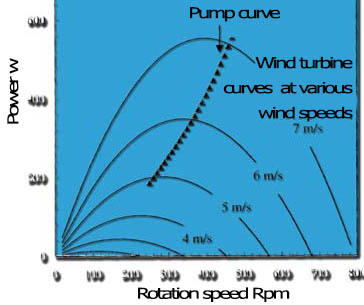
Wind turbine curves for winds of 4 to 7 m/s, and the centrifugal pump curve, adapted to pass close to the peak of each curve: the rotor stays near its best efficiency at every wind speed. The labels in the figure are in French.
5: Wind turbine with an electric pump: separating generation from pumping
Coupling an electric pump system to a power-generating wind turbine is an attractive solution, with several advantages:
- We can locate the electricity generation away from the pumping site: the wind turbine goes on a windy rise, and the electricity is carried to the pump, placed at the water level.
- The pump can sit at the bottom of the well. It thus allows pumping from more than 8 metres deep, which was sometimes out of reach with other wind turbines.
- The electricity produced can also supply other electrical appliances.
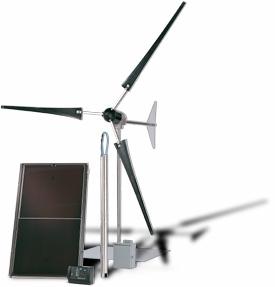
An electric wind pump kit: a three-blade generating wind turbine, completed here by a solar panel.
To go further, we can work out the energy of a wind turbine as a function of wind speed, compute the wind power available at your site, or study wind turbine rotor technique to design a rotor suited to your pump.
 Global site map
 Mecaflux
 Tutorials Mecaflux Pro3D
 Tutorials Heliciel
 Tutorials Heliciel PRO CFD
 Mecaflux Store
 Compare software functions
 Quotes, Orders, Payment Methods
 project technical studies